
 whatsminer
 2025.06.20
 1K+
1K+ 0
0

1. What is a design basis for holes on an uniform flow support plate inside Tank?
Allocate flow based on thermal difference between a PCB area and t power supply area (with a flow proportion of the power supply area being 5-10%).
Example: The first type is "8 Φ10 holes for large heat dissipation area on PCB & 8 Φ10 holes for small heat dissipation area on PCB & 5 Φ5 holes for power supply area"
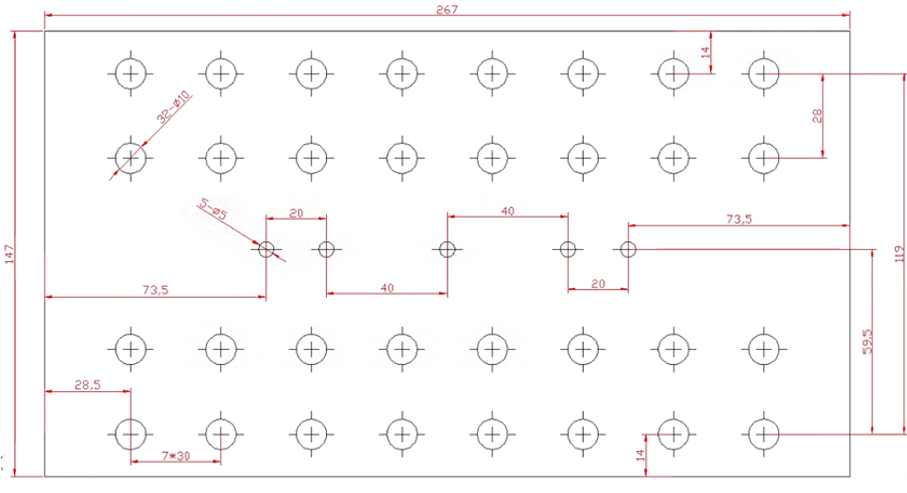
Figure 1-1
2. When designing locations for multiple miners in Tank, what are the key considerations?
It is necessary to consider a location of each miner and the flow balancing design for different areas of immersion cooling miners to ensure uniform flow of cooling liquid and avoid localized overheating.
3. What are temperature resistance requirements for components in an immersion cooling system? What are risks if these requirements are not met?
It is recommended to use components with a temperature resistance of ≥85℃; if the temperature is below 85℃, it is easy to cause component damage, liquid medium leakage, and further damage to immersion cooling miners.
4. What should be noted when placing and removing an immersion cooling miner into and from Tank?
Check whether the voltage of a PDU is normal before powering it on. If the voltage of the PDU is abnormal, a corresponding tank needs to be powered off for check.
During an operation of the double system, pay attention to whether there are water droplets mixed in the coolant in Tank. If there are water droplets, there may be a leakage in a plate heat exchanger, causing water to enter the coolant. At this time, Tank needs to be stopped immediately.
When a failure rate of the immersion cooling miners in a single system reaches 10% or more, shut down and check immediately.
It is recommended to power on the immersion cooling miners in batches when powering on to prevent the damage from surges.
During the operation, check all materials in contact with the coolant from time to time for compatibility, such as sealing rings, network cables, power supply cables, and the like, and replace them in time if there is any abnormality.
The immersion cooling miner must be powered on and turned on after the coolant circulates normally.
Removing the immersion cooling miner from Tank can cause a liquid level of Tank to decrease. Pay attention to the liquid level to ensure that the liquid return port does not inhale the air.
The power supply cables must be original accessories from the factory.
Press a shrapnel when unplugging the power supply cable.
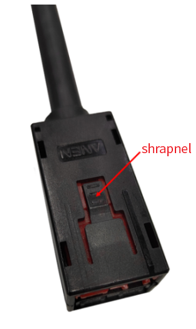
Figure 4-1
5. Before putting a miner into Tank, it may be necessary to inject liquid into the immersion system, how should this be specifically done?
If it is a double cycle system, first fill the system with the water and test the pressure, observe whether there is water flowing out from a Tank side, and confirm that hot and cold sides of a heat exchanger are completely isolated and not connected. After the coolant is injected into the system, the circulating pump starts a cycle at a low frequency and in an intermittent manner to evacuate air in the system. After the air in the system is evacuated and the coolant circulates stably for one to two hours, confirm whether a filter is clean. After confirming that the filter is clean, put an immersion cooling miner into Tank, and collect the excess coolant. The coolant level needs to be high enough to ensure that a liquid return port does not inhale the air.
6. Before putting a miner into Tank, it is necessary to conduct pressure testing on system piping, how should this be specifically done?
After installing all system components, it is recommended to perform pressure tests and leakage tests to ensure that there are no leakages in connections of all system components. It is recommended to use a water test when using the water for the cycle, and ensure that there is no leakage under a water test pressure of 6 bar. It is recommended to use a nitrogen gas test when using the coolant for the cycle and use a soap bubble method to test sealing positions of connectors, and ensure that there is no leakage under a gas test pressure of 4 bar. If an air compressor is used for the gas test, there is a risk of condensation in the air, which may cause the water to mix into the system. There are risks in directly injecting the coolant for the pressure test. Once the leakage occurs, it is difficult to collect the coolant.
7. Before putting a miner into Tank, how should a immersion system be deployed?
Before deploying the immersion cooling miners, after the system is installed and filled with the coolant, the coolant should be circulated for 1 hour, then 100 ml samples are taken from the liquid return port of Tank, the liquid injection port of Tank, and other areas where impurities may be the most. Among them, the number of particles greater than or equal to 5 μm in the100 ml samples should be less than or equal to 500, the number of particles greater than or equal to 15 μm should be less than or equal to 100, and there are no particles larger than 50 μm (based on a cleanliness level NAS 3 of NAS 1638 standard). If the cleanliness level does not meet the standard, the system is connected to a 5 μm high-precision filter apparatus with an independent booster pump for circulating and filtering the coolant until the cleanliness level meets the standard.
Note: A test method for the number of particles (5 μm) is as follows. Take 100 ml of coolant or flushing water sample and let it pass through a filter paper with a diameter of 39 mm, a mesh of 3 mm 3 mm, and a mesh of 5 μm, then observe the filter paper under a microscope, select 12 grids at random, count the number of particles thereon, and then calculate an average number of particles on each grid δ, where δ ≤ 5003²/(π*39²/4) = 4.
The immersion cooling miner uses a bottom-in and top-out coolant cycle flow method to dissipate heat. Therefore, the immersion cooling miner needs to be placed in an immersion cooling Tank that allows the coolant to flow in and out from the inside of the immersion cooling miner. A liquid equalization support plate at the bottom of the immersion cooling Tank needs to support the immersion cooling miner. The coolant passes through the liquid equalization support plate and a bottom panel of the immersion cooling miner and directly enters the immersion cooling miner, and flows out from a top side or an upper panel of the immersion cooling miner, as shown in the following figure. The immersion cooling miner can be put into Tank and taken out Tank by one person.
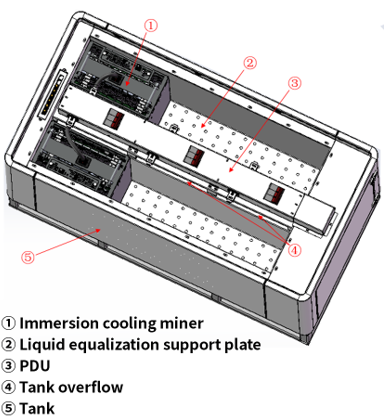
Figure 7-1
8. Introduction to Cleaning Immersion Cooling System
Regarding the immersion cooling system, to ensure the cleanliness of the entire system, it is recommended to first ensure the cleanliness of finished products of various key components, including circulating pumps, Tank, radiators, prefabricated pipeline and pipes, and the like. Secondly, when designing the system, it is recommended that a main pipeline system reserve a bypass to connect an additional system cleaning apparatus with a pressure boosting function, which is equipped with a fine filter of 5 μm or more.
Before assembling a system, all components in the system must be confirmed to be clean. If the components are not clean enough, clean them before installing the system.
During an installation process of each component in the system, cleanliness inside the devices must also be ensured, including pipeline, pipes, Tank and radiators. For example, when installing a certain pipe, only remove packaging of the pipe, and do not remove the packaging of other devices. If foreign particles are accidentally mixed into a certain component during the installation process, clean it with a clean cloth or a vacuum cleaner in time. Moreover, in an installation suspension period, seal and protect the components that have been unpacked but not yet installed or put into use.
Before injecting the coolant into the system, confirm again whether the entire system is clean, including a circulating pump, pipes, Tank, radiators, and the like, and ensure that there are no obvious water stains, dust, metal chips, welding slag impurities, and the like.
Note:
a) A new circulating pump will be tested before leaving the factory, so there will be residual water inside. It is recommended to clean the residual water before leaving the factory or using it.
b) Regarding to processing technologies of the prefabricated pipeline and pipes, Tank and radiators, it is recommended to have a cleaning and drying process to ensure that there are no water stains, dust, metal chips, welding slag impurities, and the like. After cleaning and drying, seal as soon as possible to prevent internal contamination by dust and impurities.
c) The system cleaning apparatus with the pressure booster function herein refers to an independent cleaning apparatus with a booster pump, which is only used when the system needs cyclic cleaning, and does not need to be connected during a normal operation of the system.
Before deploying the immersion cooling miners, after the system is installed and filled with the coolant, the coolant should be circulated for 1 hour, then 100 ml samples are taken from the liquid return port of Tank, the liquid injection port of Tank, and other areas where impurities may be the most. Among them, the number of particles greater than or equal to 5 μm in the100 ml samples should be less than or equal to 500, the number of particles greater than or equal to 15 μm should be less than or equal to 100, and there are no particles larger than 50 μm (based on a cleanliness level NAS 3 of NAS 1638 standard). If the cleanliness level does not meet the standard, the system is connected to a 5 μm high-precision filter apparatus with an independent booster pump for circulating and filtering the coolant until the cleanliness level meets the standard.
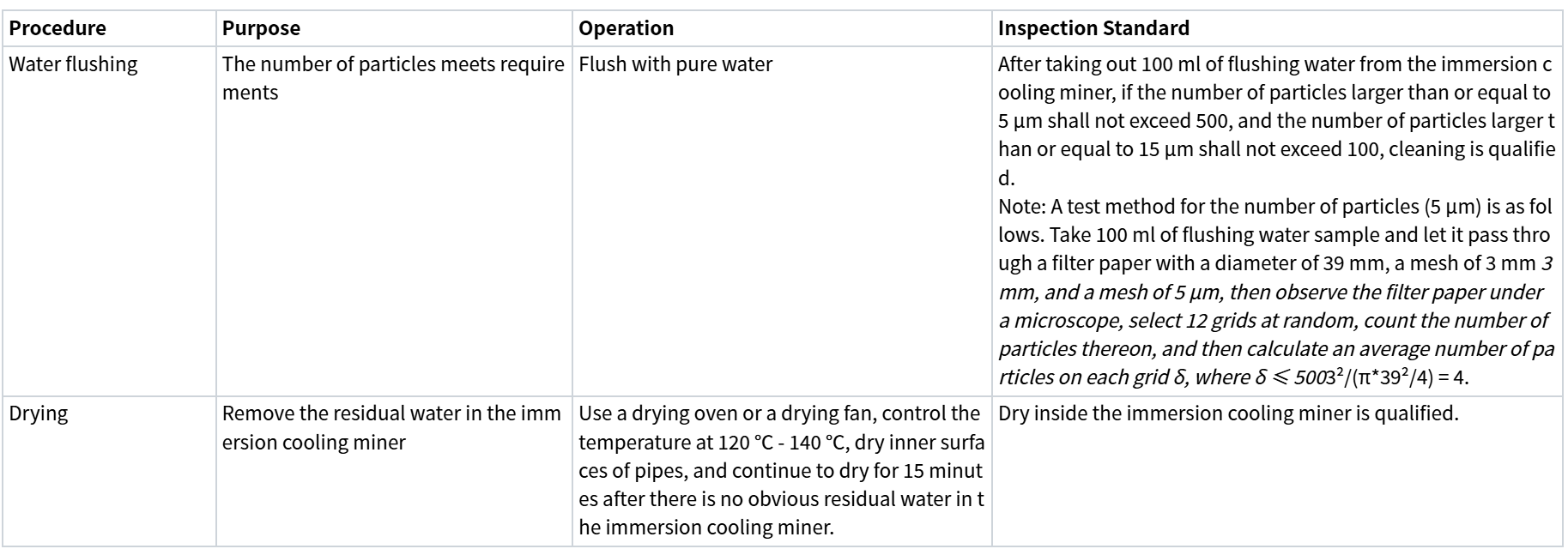
The operating procedures are shown in the table below.
 Yes
Yes No
No Feedback
- 1WhatsMinerTool_Operation Guide16K+
- 2WhatsMiner Hydro-Cooling Miner_Operation Guide12K+
- 3WhatsMiner Air Cooling Miner_Operation Guide12K+
- 4WhatsMiner API_User's Manual9K+
- 5WhatsMiner Immersion Cooling Miner_Operation Guide7K+
- 6WhatsMinerTool: Performance, Power & Remote Functions Q&A7K+
- 7WhatsMinerTool Overclocking Guide7K+
- 8Simple introduction to quick connectors for hydro-cooling miners6K+
- 9Overclocking Eligibility & Performance Impact Q&A5K+
- 10WhatsMiner Hydro-Cooling Series Installation & Removal Guide4K+