
 whatsminer
 2026.05.13
 1K+
1K+ 0
0

1. What operations need to be completed before putting hydro-cooling miner into a cabinet?
It is necessary to inject liquid for circulation, evacuate air inside hydro-cooling plates of hydro-cooling miners, and fill the hydro-cooling plates with the liquid. You can also put one hydro-cooling miner at a time and wait for liquid replenishment to be completed before moving on to the next one.
2. What key information should I know before putting a hydro-cooling miner into a cabinet?
You need to determine an installation position of a miner first. Hydro-cooling miners typically adopt a standard 2U structure design.
Cabinets are typically customized, and different types can be selected based on the number of miners (e.g., a standard 19-inch hydro-cooling cabinet).
When you receive the miner, it is already in an integrated state and require no additional installation—you only need to place it into the cabinet.
Even customized cabinets must be equipped with circuit breakers.
3. What key details need to be confirmed before powering on hydro-cooling miners?
It is necessary to confirm that a hydro-cooling cycle system is functioning properly, air inside pipes has been evacuated, and there are no leaks in the hydro-cooling cycle system.
4. What are key points to note when putting a hydro-cooling miner in a cabinet?
Step 1: Two people are required to slowly push a miner into a cabinet along a rack slot.
Step 2: Align fixing holes on a front plate with floating nuts and secure them with screws.
Step 3: Connect a quick connector for an inlet (blue) and a quick connector for an outlet (red), ensuring they are securely engaged.
Step 4: Connect a network cable and a power supply cable.
Step 5: Perform a water circulation test before energizing the miner to thoroughly check for any leaks.
5. For a hydro-cooling miner (M63&m73 series), what precautions should be taken when connecting the power supply cable and network cable of the miner?
Power supply cable: You must use the original factory-configured power supply cable that comes with each miner. For safety, do not use non-original cables. If you need to purchase additional cables later, contact our after-sales service personnel. For example, regarding a hydro-cooling miner, a socket interface definition of the miner's power supply cable is shown in the figure.

Figure 5-1
Network cable: Use the most common network cables, such as those used in computers.
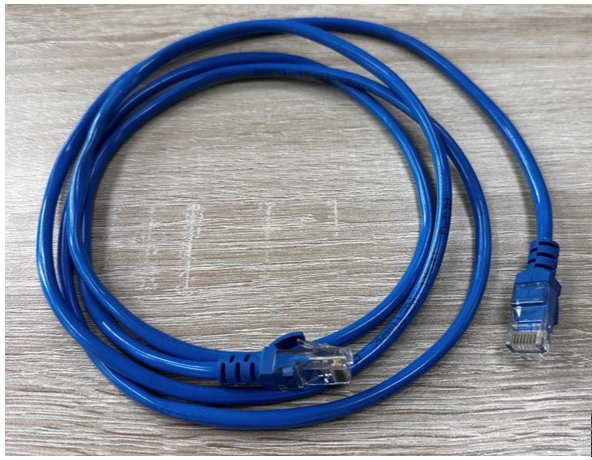
Figure 5-2
The schematic diagram showing the completed connection of power supply cable and network cable is as follows.
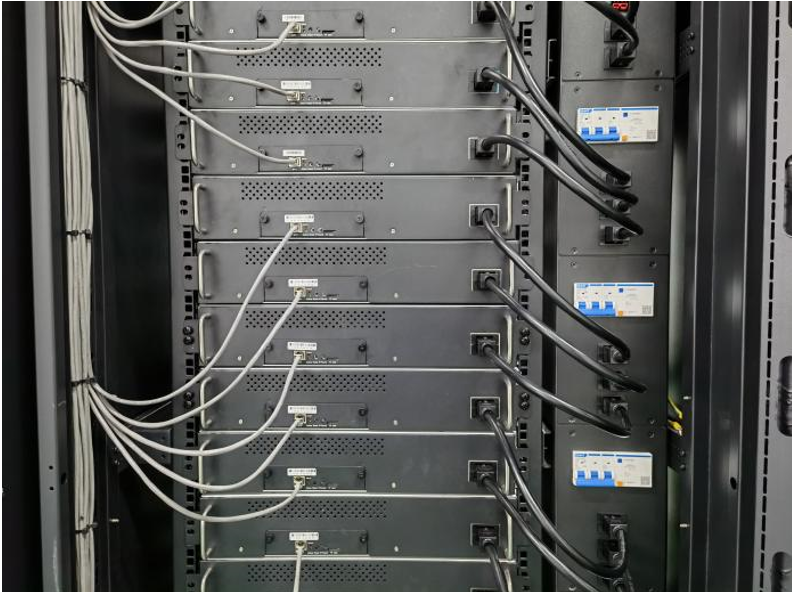
Figure 5-3
6. What is a checklist for a hydro-cooling before operation?
Before operating a hydro-cooling miner, you should complete a checklist, See the following four points for details.
1) Before powering on a hydro-cooling miner, confirm that a hydro-cooling system is circulating normally, that is, confirm that air in pipes has been emptied and the hydro-cooling system has no leaks.
Note: If there is the air in the pipes, there is a risk of damage to a circulating pump. Inlet and outlet connectors and intermediate connecting pipes of the hydro-cooling miner need to be carefully inspected. If there is slight leakage, you need to deal with it in a timely manner, otherwise, leakage points may pose a risk of damage to the hydro-cooling miner, which will affect a normal operation of the hydro-cooling system over time. We will shoulder no responsibility for such damage to the miner.
2) When all hydro-cooling miners sharing the same hydro-cooling system are powered on at the same time, in order to avoid overheat protection of the hydro-cooling miner due to out-of-control liquid temperature control of the hydro-cooling system, it is recommended that before all the hydro-cooling miners are powered on, temperature-controlled components of the hydro-cooling system, such as draught fans, circulating pumps, and electric valves, run at full load. After the power of the hydro-cooling miner rises close to the rated power, the hydro-cooling system enters a state of automatic liquid temperature control and adjustment.
3) Before putting all the hydro-cooling miners into the cabinet, you need to inject the liquid for cycling to empty air in a cooling plate of the hydro-cooling miner, and then fill the cooling plate with the liquid. Or you can put one hydro-cooling miner into the cabinet at a time, and then put the next hydro-cooling miner after liquid replenishment is complete.
Note: Under normal circumstances, there is no liquid in the cooling plate of the hydro-cooling miner. When the hydro-cooling miner is communicated with the hydro-cooling system, the air will enter pipes, leading to liquid shortage in the hydro-cooling system. Therefore, it is necessary to have an exhausting apparatus and an automatic liquid replenishment apparatus. When the hydro-cooling system operates, it is not possible to connect multiple hydro-cooling miners without liquid at the same time in a short period of time. Because at this time, the hydro-cooling system will suddenly lack a large amount of liquid, and if the liquid replenishment is not timely, the air will mix into the hydro-cooling system, so that damage can be easily caused to a pump when it runs with gas, and local overheat of chips can be caused in other hydro-cooling miners, burning out the hydro-cooling miners or affecting hashrate. We will shoulder no responsibility for such damage to the miner.
4) Confirm that non-condensing exists on the hydro-cooling miner.
Note: When the hydro-cooling miner is not operating, if the ambient temperature rises from the lower temperature to the higher temperature, the temperature of the hydro-cooling miner itself cannot keep up with changes in the ambient temperature, and condensing may occur. If the condensing occurs, the hydro-cooling miner can be heated and dried by heating methods such as solar irradiation. We will shoulder no responsibility for such damage to the miner.
7. What are precautions for operating a hydro-cooling miner?
1) A female quick connector and a power supply cable must be the original factory-configured female quick connector and power supply cable. We will shoulder no responsibility for such damage to the miner.
2) After a female quick connector is plugged into a male quick connector normally, the two quick connectors are communicated with each other and liquid can flow. The two quick connectors can lock themselves, and when the female quick connector is pulled out, the female quick connector and the male quick connector will shut off in both directions without liquid leakage. After the female quick connector is plugged into the male quick connector, you can check if there is any loose connection between the two quick connectors by pulling a hose at head of a pagoda joint of the female quick connector.
Note: If the female quick connector is not actually plugged into the male quick connector, the hydro-cooling miner may not function or even a cooling plate may be damaged due to overheat protection. We will shoulder no responsibility for such damage to the miner.
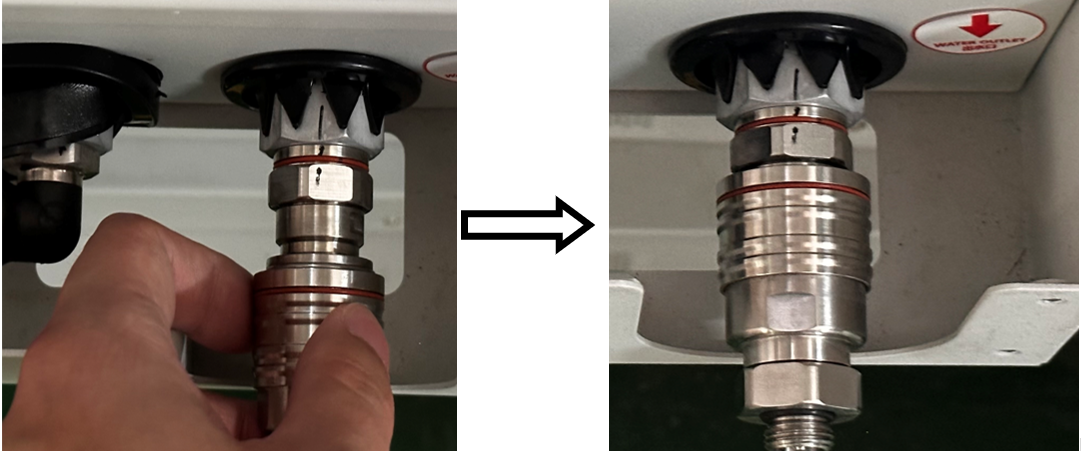
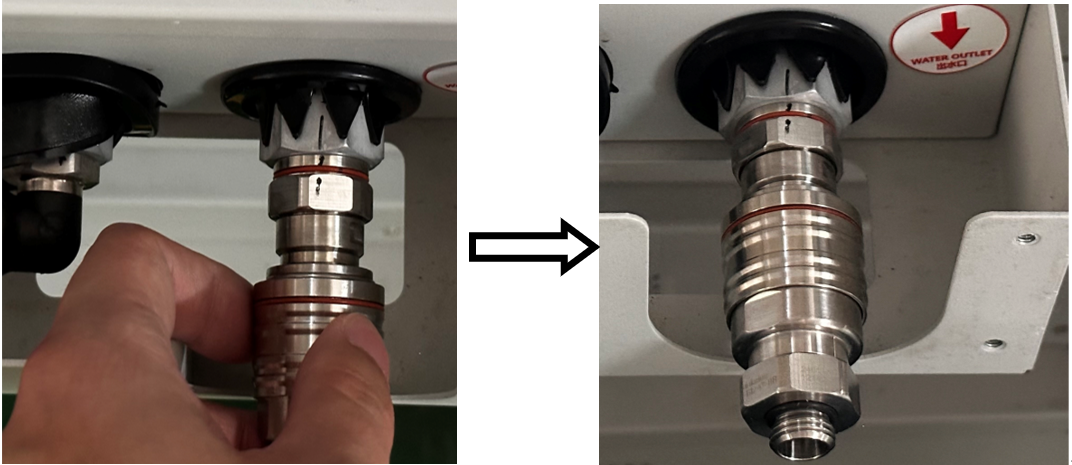
3) When you plug the female quick connector into the male quick connector, hold the head of the pagoda joint of the female quick connector and push it forward into place. During this process, be careful not to hold a movable ring.
Correct example (female quick connector has been pushed in place)✔
Wrong example (female quick connector is not pushed in place)❌
8. What network related devices are necessary when configuring a miner?
Computers, power supplies, network switches, DHCP servers/routers, NTP servers/routers
9. What are precautions after taking a hydro-cooling miner out from a cabinet?
After taking a hydro-cooling miners out from a cabinet, it is necessary to drain liquid in the hydro-cooling miners to prevent damage to hydro-cooling plates.
10. What are environmental requirements for storing a hydro-cooling miner?
Temperature range: -40°C to +70°C (If storage/transportation time exceeds 2 hours, liquid must be drained).
Humidity: Short-term storage: Relative humidity 5%-95% (non-condensing). Long-term storage: Relative humidity 30%-69% (non-condensing).
11. What precautions should be taken when transporting a hydro-cooling miner?
1) Keep the miners in their original packaging;
2) Secure them firmly in transport vehicles to prevent shifting or tipping;
3) Handle gently to avoid drops, bumps, and vibration;
4) Keep dry and shaded (protect from rain, moisture, and direct sun).
12. What should be done if condensation occurs on hydro-cooling miners?
Hydro-cooling miners can be warmed and dried using heating methods such as exposure to sunlight, so as to solve a problem of condensation.
13. Why can't multiple hydro-cooling miners with no liquid be connected to a hydro-cooling cycle system in a short period of time?
Because at this time, a hydro-cooling cycle system will suddenly experience a large shortage of liquid. If the liquid is not replenished in time, air will mix into the hydro-cooling cycle system, causing a water pump to run with the air and be damaged. At the same time, it may also cause local overheating of chips in other hydro-cooling miners, burning out the hydro-cooling miners or affecting hashrate.
14. What are operational recommendations when all hydro-cooling miners in a same hydro-cooling cycle system are powered on simultaneously?
Before powering on all hydro-cooling miners, it is recommended to allow temperature control components of a hydro-cooling cycle system (such as fans, circulation pumps, electric valves, etc.) to run at full load. After the power of the hydro-cooling miners approaches the rated power, let the hydro-cooling cycle system enter a state of automatic liquid temperature control and regulation to avoid overheating protection caused by uncontrolled liquid temperature control.
15. The operation guide for hydro-cooling miners suggests that liquid inside the miners should be completely drained during storage and transportation. If the miners suddenly or temporarily taken away from a cabinet and the liquid in the miners is not completely drained, what impact will it have?
If liquid in hydro-cooling miners is not completely drained during storage and transportation, it will cause the following impacts.
If there is no corrosion inhibitor: excessive pressure inside hydro-cooling plates may cause the hydro-cooling plates to bulge, thereby damaging the hydro-cooling plates and hashboard.
If the corrosion inhibitor recommended by WhatsMiner is added, there is usually no obvious problem within one week, but the above-mentioned damage risk may still occur beyond this period.
16. What are the dimensions of M66S++ without the handle?
The dimension of M66S++ without handle is 267.5 mm x 147 mm x 369 mm, that is, 10.53" × 5.79" × 14.53".
17. Is it possible to install M63 series vertically on the wall or does the miner always have to be in a horizontal position?
M63 series can be installed vertically on the wall, and it does not always have to be in a horizontal position. Actually, an installation method of M63 series does not have much impact.
 Yes
Yes No
No Feedback
- 1WhatsMinerTool_Operation Guide16K+
- 2WhatsMiner Hydro-Cooling Miner_Operation Guide12K+
- 3WhatsMiner Air Cooling Miner_Operation Guide12K+
- 4WhatsMiner API_User's Manual9K+
- 5WhatsMiner Immersion Cooling Miner_Operation Guide7K+
- 6WhatsMinerTool: Performance, Power & Remote Functions Q&A7K+
- 7WhatsMinerTool Overclocking Guide7K+
- 8Simple introduction to quick connectors for hydro-cooling miners6K+
- 9Overclocking Eligibility & Performance Impact Q&A5K+
- 10WhatsMiner Hydro-Cooling Series Installation & Removal Guide4K+